Executive summary
Quantum computers differ from classical machines because they operate on qubits—quantum systems that can occupy a combination of two basis states. Superposition, entanglement and reversible unitary gates enable algorithms that could eventually outperform classical approaches for certain scientific problems. Today’s devices are noisy, have limited qubit counts and require shallow circuits. Enterprises can use cloud‑based quantum processors for research, prototyping and education, but must treat results as experimental data rather than production‑ready outputs.
Introduction
The promise of quantum computing rests on three uniquely quantum phenomena: superposition, entanglement and interference. A qubit is a two‑level quantum system such as a superconducting circuit, trapped ion, photon, quantum dot or neutral atom. IBM’s educational material defines a qubit as a system prepared so that it can be treated as a two‑level device, with its state described by two complex amplitudes α and β that satisfy |α|²+|β|²=1. Measurement collapses the state to a classical bit, returning either 0 or 1 with probabilities given by those squared magnitudes. Because a single measurement yields only one outcome, experiments repeat the circuit many times—IBM calls each repetition a “shot”—to estimate the underlying probability distribution.
Technical fundamentals
Qubit state and superposition
An arbitrary single‑qubit state is written as α|0⟩+β|1⟩. The amplitudes are complex numbers; their squared magnitudes are the chances of observing each basis state. The Hadamard gate creates an equal superposition from |0⟩, giving amplitudes 1/√2 for both |0⟩ and |1⟩. Applying a Pauli‑X (bit‑flip) before the Hadamard yields the |‑⟩ state, which has a relative minus sign between the basis components.
Entanglement
Entanglement is a correlation that cannot be expressed as a product of independent qubit states. IBM demonstrates it by applying a Hadamard to the first qubit of a two‑qubit register, then a controlled‑NOT (CNOT) with that qubit as control and the second as target. The resulting Bell state, (|00⟩+|11⟩)/√2, yields only the bit strings 00 and 11 in an ideal measurement. A three‑qubit GHZ state is built by chaining additional CNOTs. Entanglement does not enable faster‑than‑light communication; it merely makes the joint state more powerful for algorithmic purposes.
Gate set and circuit depth
IBM’s lesson lists the Pauli‑X, Pauli‑Z, and Hadamard as fundamental single‑qubit unitaries. Unitary operations are reversible and preserve normalization. Multi‑qubit gates such as CNOT are the primary source of entanglement. Circuit depth is defined as the longest path of gates, counting each multi‑qubit gate as a connection that can change wires. On noisy hardware, lower depth reduces exposure to decoherence and gate error, improving the fidelity of the final measurement.
Architecture and components
| Qubit type | Control method | Error‑correction status |
|---|
| Superconducting | Microwave pulses | Emerging |
| Trapped ion | Laser pulses | Emerging |
| Photons | Linear optics / detectors | Emerging |
| Quantum dots | Electrical gating | Emerging |
| Neutral atoms | Optical tweezers | Emerging |
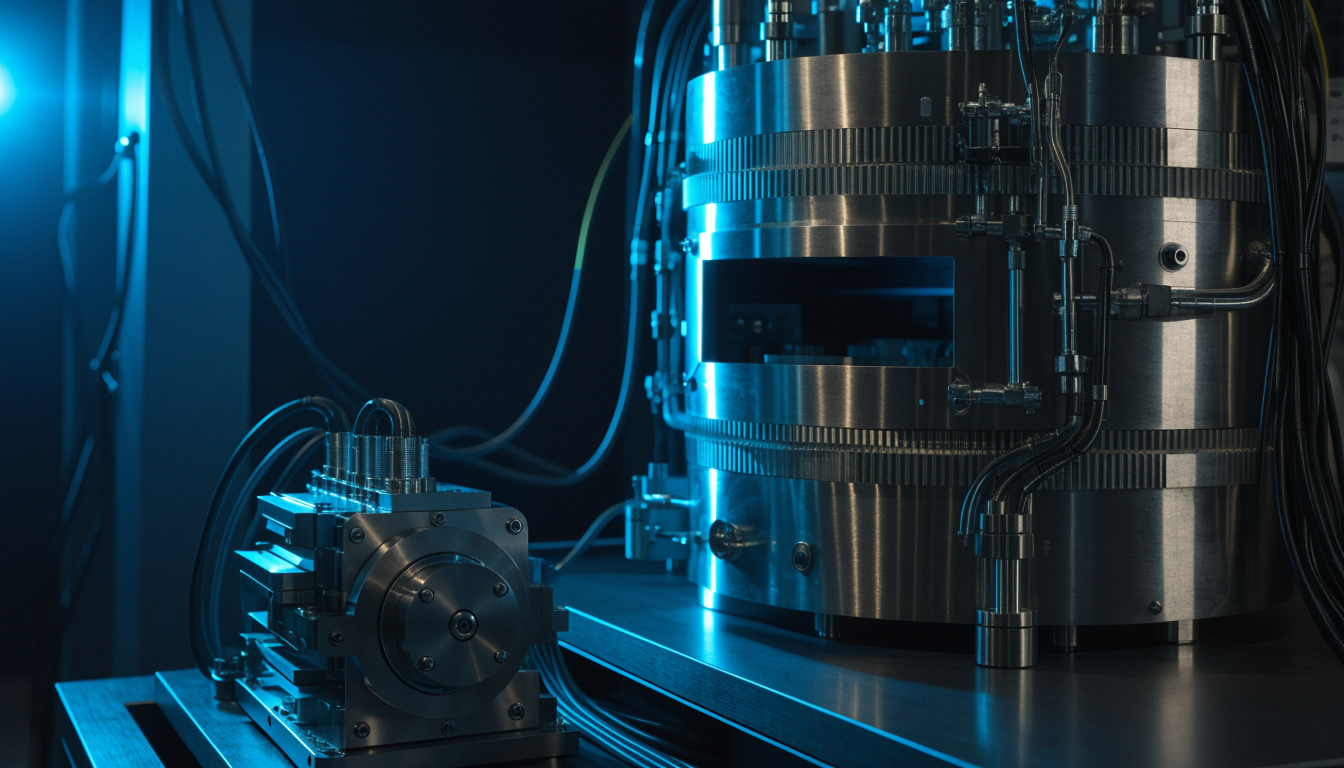
Superconducting qubits operate at millikelvin temperatures inside dilution refrigerators and are manipulated with microwave pulses. Trapped‑ion qubits reside in ultra‑high vacuum chambers and are driven by laser beams; they exhibit long coherence times and high‑fidelity readout. Photonic qubits are natural for quantum communication but are less common in gate‑based processors. The IBM pages stress that error‑correction remains an emerging research area; no current device offers fully fault‑tolerant operation.
Detailed implementation approach
To run a circuit on IBM’s cloud platform, a developer writes a quantum program using the Qiskit SDK or a visual composer. The code is first transpiled: an abstract circuit is mapped onto the native gate set and connectivity of the chosen device. Transpilation can increase gate count and depth because the hardware may lack direct connections between arbitrary qubits. After transpilation, the program is submitted as a job; the service queues it, executes the required number of shots, and returns a histogram of measurement outcomes.
from qiskit import QuantumCircuit, Aer, execute
qc = QuantumCircuit(2, 2)
qc.h(0)
qc.cx(0, 1)
qc.measure([0,1], [0,1])
backend = Aer.get_backend('qasm_simulator')
result = execute(qc, backend, shots=1024).result()
print(result.get_counts())
The example illustrates the exact gate sequence described in IBM’s learning material. On a real processor, the returned histogram would show a dominant 00 and 11 count, with a few 01 and 10 results caused by noise.
Architecture and data‑flow
A typical cloud‑based workflow consists of three layers:
- User layer – developers write circuits in a high‑level language (Qiskit, OpenQASM, or a graphical interface).
- Compilation layer – the platform’s transpiler maps logical qubits to physical qubits, inserts necessary swap gates to respect connectivity, and optimizes depth.
- Execution layer – the quantum processing unit (QPU) receives calibrated microwave or laser pulses, performs the gate sequence, and measures the qubits. Results are digitized, aggregated into a histogram and streamed back to the user.
Data‑flow is unidirectional: quantum information flows from the control electronics into the qubits and back as classical bits. No quantum data leaves the cryogenic environment, preserving security boundaries.
Security and governance
Quantum‑computing services inherit the security model of the underlying cloud provider. Access is controlled via API keys and role‑based permissions. Because quantum operations are reversible and do not expose raw quantum states, the primary risk is the leakage of proprietary circuit designs. Organizations should treat quantum code as intellectual property, store it in secure version‑control systems, and limit job‑submission rights to authorized personnel.
Enterprise use cases
IBM’s material lists research‑oriented domains where quantum advantage may eventually appear: drug discovery, climate modeling, machine learning and artificial intelligence. At present, enterprises can use quantum processors for:
- Algorithm prototyping – testing small‑scale versions of variational quantum eigensolver (VQE) or quantum approximate optimization algorithm (QAOA) on a few qubits.
- Benchmarking hardware – measuring gate fidelity, coherence times and error rates for vendor comparison.
- Education and talent development – training engineers and data scientists on quantum concepts using the free IBM Quantum Lab.
No source claims a production‑grade business application is currently running on IBM’s publicly available devices.
Benefits and limitations
Benefits
- Ability to represent and manipulate exponential state spaces with a linear number of qubits.
- Entanglement provides correlations that can accelerate certain algorithms.
- Cloud access lowers entry barriers for experimentation.
Limitations
- Qubit counts are modest (single‑digit to low‑double‑digit) and coherence times are short.
- Noise introduces errors; shallow circuits are required for reliable results.
- Full error‑corrected, fault‑tolerant operation is still an emerging research field.
- No vendor currently offers a guaranteed production‑grade service for mission‑critical workloads.
Operational considerations
When planning quantum experiments, teams should:
- Choose the hardware platform that matches the control method they can support (microwave for superconducting, laser for ions).
- Keep circuit depth minimal and respect the native gate set to reduce transpilation overhead.
- Use a sufficient number of shots (hundreds to thousands) to obtain statistically meaningful histograms.
- Track device calibration metrics (gate error, readout error, coherence) provided by the provider and schedule runs during periods of optimal performance.
- Expect queue times; cloud‑based QPUs are shared resources.
Best practices
- Start with simulators – verify logical correctness before submitting to hardware.
- Use native gates – map high‑level algorithms onto the device’s native gate set to avoid excessive transpilation.
- Limit qubit connectivity – design circuits that fit the device’s coupling map, reducing the need for SWAP gates.
- Iterate with noise mitigation – apply error mitigation techniques such as measurement error correction and zero‑noise extrapolation, as recommended in IBM’s learning modules.
- Document calibration data – record the device’s error rates at the time of each run for reproducibility.
Analysis
The IBM resources present quantum computing as an educational platform rather than a production service. The description of superposition, entanglement and gate operations is precise and avoids overstating capability. The hardware discussion acknowledges that coherence and error rates limit circuit depth, and that quantum error correction is still emerging. Consequently, the realistic enterprise approach is to treat quantum runs as exploratory experiments, not as components of a live business process. Vendors’ claims about future breakthroughs are speculative; the material does not provide concrete benchmarks or performance guarantees.
What the sources do not settle
- Exact timeline for fault‑tolerant hardware – both sources label error correction as emerging but give no schedule for when a fully error‑corrected processor will be available.
- Comparative cost analysis – the notes list hardware options but do not quantify cost per qubit, operational expense or total cost of ownership.
- Standardized performance metrics – while gate error and coherence are mentioned, there is no universally accepted benchmark for comparing devices across platforms.
- Enterprise‑grade integration patterns – the material does not describe how quantum results would be incorporated into existing data pipelines or decision‑making workflows.
Conclusion
Quantum computers operate on qubits that can exist in superposition and become entangled, enabling algorithmic possibilities unavailable to classical machines. IBM’s educational content provides a clear, accurate foundation: qubits are described as two‑level quantum systems, gates are defined as unitary operations, and entanglement is illustrated with the Hadamard‑CNOT Bell‑state circuit. Hardware platforms differ in control method and coherence, and error correction remains an active research area. For enterprises, the prudent path is to use cloud‑based quantum processors for learning, small‑scale prototyping and hardware benchmarking while recognizing that production‑ready quantum services are not yet delivered. Continued monitoring of hardware improvements and error‑mitigation techniques will be essential as the field matures.
References
These published CloudExchangers articles are further desk reading. They are not sources for the technical claims above.